Create a bootable installer for macOS
You can use an external drive or secondary volume as a startup disk from which to install the Mac operating system.
These advanced steps are primarily for system administrators and other experienced users who are familiar with entering commands in Terminal.
You don’t need a bootable installer to upgrade macOS or reinstall macOS, but it can be useful if you want to install macOS on multiple computers without downloading the installer each time, or you're unable to install a compatible macOS from the Finder or macOS Recovery.
What you need to create a bootable installer
- A USB flash drive or other secondary volume with at least 14 GB of available storage, formatted as Mac OS Extended
- A full macOS installer. To get a full installer, download from a Mac that is using macOS High Sierra or later, the latest version of macOS Sierra or the latest version of OS X El Capitan. The Mac must also be compatible with the macOS you’re downloading. Enterprise administrators: download from Apple, not a locally hosted update server.
Download a macOS installer using the App Store or your web browser
Use Terminal to create the bootable installer
- Plug in the USB flash drive or other volume that you're using for the bootable installer.
- Open Terminal, which is in the Utilities folder of your Applications folder.
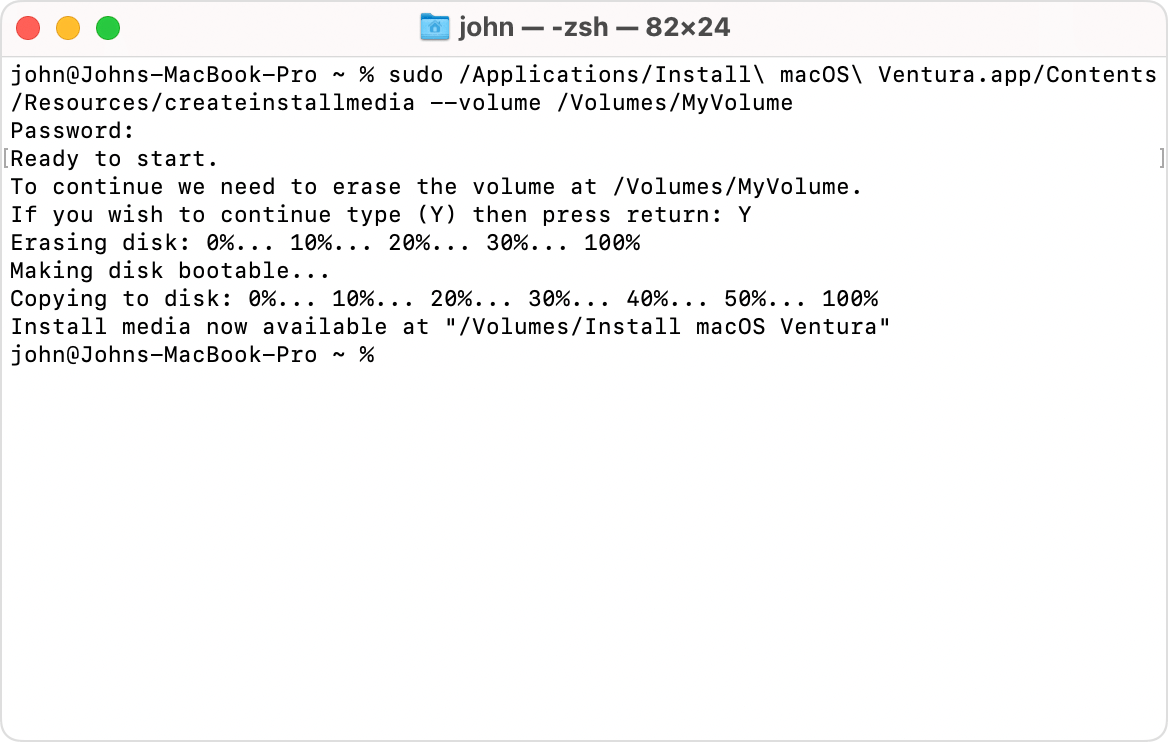
- Type or paste one of the commands below into Terminal, then press Return to enter the command. Each command assumes that the installer is in your Applications folder, and that MyVolume is the name of the USB flash drive or other volume you’re using. If the volume has a different name, replace
MyVolumein the command with the name of your volume. - When prompted, type your administrator password. Terminal doesn't show any characters as you type. Then press Return.
- When prompted, type Y to confirm that you want to erase the volume, then press Return. Terminal displays the progress as the volume is being erased.
- After the volume has been erased, you may see an alert stating that Terminal would like to access files on a removable volume. Click OK to allow the copy to proceed.
- When Terminal says that it’s finished, the volume will have the same name as the installer you’ve downloaded, such as Install macOS Sonoma. You can now quit Terminal and eject the volume.
Commands
Depending on which macOS you downloaded, enter one of the following commands in Terminal as instructed above.
- Remember to replace MyVolume in the command with the name of your volume.
- If your Mac is using macOS Sierra or earlier, append
--applicationpathwith the appropriate installer path, similar to what is shown in the command below for El Capitan.
macOS Sonoma
sudo /Applications/Install\ macOS\ Sonoma.app/Contents/Resources/createinstallmedia --volume /Volumes/MyVolume
Ventura
sudo /Applications/Install\ macOS\ Ventura.app/Contents/Resources/createinstallmedia --volume /Volumes/MyVolume
Monterey
sudo /Applications/Install\ macOS\ Monterey.app/Contents/Resources/createinstallmedia --volume /Volumes/MyVolume
Big Sur
sudo /Applications/Install\ macOS\ Big\ Sur.app/Contents/Resources/createinstallmedia --volume /Volumes/MyVolume
Catalina
sudo /Applications/Install\ macOS\ Catalina.app/Contents/Resources/createinstallmedia --volume /Volumes/MyVolume
Mojave
sudo /Applications/Install\ macOS\ Mojave.app/Contents/Resources/createinstallmedia --volume /Volumes/MyVolume
High Sierra
sudo /Applications/Install\ macOS\ High\ Sierra.app/Contents/Resources/createinstallmedia --volume /Volumes/MyVolume
El Capitan
sudo /Applications/Install\ OS\ X\ El\ Capitan.app/Contents/Resources/createinstallmedia --volume /Volumes/MyVolume --applicationpath /Applications/Install\ OS\ X\ El\ Capitan.app
Use the bootable installer
Determine whether you're using a Mac with Apple Silicon, then follow the appropriate steps. Remember that the Mac you’re starting up from the bootable installer must be compatible with the macOS on the bootable installer. If not, it may start up to a circle with a line through it.
Mac with Apple silicon
- Plug the bootable installer into a Mac that is connected to the internet and compatible with the version of macOS you're installing. A bootable installer doesn't download macOS from the internet, but it does require an internet connection to get firmware and other information specific to the Mac model.
- Turn on the Mac and continue to hold the power button until you see the startup options window, which will display your bootable volumes.
- Select the volume containing the bootable installer, then click Continue.
- When the macOS installer opens, follow the onscreen installation instructions.
Any other Mac
- Plug the bootable installer into a Mac that is connected to the internet and compatible with the version of macOS you're installing. A bootable installer doesn't download macOS from the internet, but it does require an internet connection to get firmware and other information specific to the Mac model.
- Turn on your Mac, then immediately press and hold the Option (Alt) key.
- Release the Option key when you see a dark screen displaying your bootable volumes.
- Select the volume containing the bootable installer. Then, click the onscreen arrow or press Return.
If you can't start up from the bootable installer, make sure Startup Security Utility is set to allow booting from external or removable media. - Choose your language, if prompted.
- Select Install macOS (or Install OS X) from the Utilities window, then click Continue and follow the onscreen instructions.
Learn more
For information about the createinstallmedia command and the arguments you can use with it, make sure the macOS installer is in your Applications folder, then enter the appropriate path in Terminal:
/Applications/Install\ macOS\ Sonoma.app/Contents/Resources/createinstallmedia
/Applications/Install\ macOS\ Ventura.app/Contents/Resources/createinstallmedia
/Applications/Install\ macOS\ Monterey.app/Contents/Resources/createinstallmedia
/Applications/Install\ macOS\ Big\ Sur.app/Contents/Resources/createinstallmedia
/Applications/Install\ macOS\ Catalina.app/Contents/Resources/createinstallmedia
/Applications/Install\ macOS\ Mojave.app/Contents/Resources/createinstallmedia
/Applications/Install\ macOS\ High\ Sierra.app/Contents/Resources/createinstallmedia
/Applications/Install\ OS\ X\ El\ Capitan.app/Contents/Resources/createinstallmedia

